French: pamplemousse English: 🙂 French: pls no English: raisinfruit
english: squirrel
german: 🙂
english: oh dear
german: oak croissant
english: helicopter
german: 🙂
english: uh oh
german: lifting screwdriver
english: toes
spanish: 🙂
english: no don’t
spanish
: fingers of the feet
english: bowl
spanish: 🙂
english: oh lordy
spanish: deep plate
english: car
polish: 🙂
english: i changed my mind
polish: that which walks by itself
french:
coccinelle
UK english: ladybird!
american english: ladybug
french: weird
dutch: 🙂
french: …what
dutch: the good lord’s little animal
french: …ok
irish, polish and russian: *giggling*
french: …just tell me
irish, polish and russian: GOD’S SMALL COW
IT’S BACK
german: Marie’s beetle
english: ankle
japanese: 🙂
english: //lies down for an eternal sleep
japanese: foot neck
English: Dragon
Finn: 🙂
English: dear god no
Finn: salmon snake
All right, several of these English has no room to complain because its versions are almost the same except it did them in a different language to start with so it’s slightly subtler:
“Car” is nice and simple and coopted from a word that meant any kind of wheeled road transport, but “automobile”? That’s self+moving, only in French.
German word for helicopter is Hubschrauber. If you take “Schrauber” by itself and try to translate it you’ll get screwdriver, but you don’t get Schrauber translating screwdriver – “Schrauber” is more like “screwer”. So it’s a lift+screw-related-thing, which isn’t very different from English’s spiral+wing-but-in-Greek.
(Also for anyone else who missed it I have just now learned raisin is French for grape! Which is… why. Who did that. Who decided to just wholesale borrow a word from another language to mean something related but not the same as. …Apparently they did it in Middle English, so there’s not a lot of point in complaining about it now. Anyway “grapefruit” is right there next to “pineapple” in the category of “puzzling word construction choices in the English language”. …The dictionary is telling me “grapefruit” is probably because they grow in clusters, but I just searched for a picture and that is nowhere near clustered enough to merit a comparison to grapes.)
Wasps are functionally the same as bees, we just hate them because they’re not as cute n can hurt you more than once without dying
Except they’re not because wasps don’t make honey, they aren’t pollinators, they’re completely different insects and serve a very different function.
Not sure where you’re getting that information from but it is not correct, as wasps are actually very important pollinators.
There are also 20,000 species of described bees and of those there are only a small handful that produce honey, and of those there are currently even less (off the top of my head I can only think of 4) species we can actually harvest any honey from.
Wasps are also pollinators, ever heard of fig wasps, there are a superfamily of wasps called Chalcidoidea and each different species of fig often has one or two very specific species of wasp needed to pollinate it.
There’s still this misconception that wasps aren’t great pollinators compared to bees but this isn’t true, wasps are just as ecologically important in pollination as bees are, and also pollinate flowering plants and trees. For example; thynnine wasps pollinate orchids like this dwarf hammer orchid.
This is super common in Australia where we have about 200 species of orchids (spider orchids, elbow orchids, flying duck orchids) that use male insects (most of which are wasp species) to pollinate.
Also most bee species can hurt you more than once without dying. Yes, honeybees have a barbed stinger and die after they sting, but not all bees are honeybees.
And, as our curator likes to say, evolutionarily speaking bees are basically just vegan wasps.
I’m so happy to see this new movement lauding the many virtues of wasps. I’ve had so many people ask me “what are they good for?” Like what the fuck are YOU good for Heather? Do you even know how many different kinds of wasps there are? Yes they’re important, dammit! An animal doesn’t become worthless just because you personally don’t like it! Your opinion means fuckall to the ecosystem! It doesn’t care!
Even honeybees don’t necessarily die after they sting, if I remember right – they just usually die after they sting humans because our skin is thicker than what they usually have to deal with. So they can’t just jab in and out and then fly off, they need a bit of time to wiggle loose…which they don’t normally get, since people freak out about a bee having stung them (understandably, that shit hurts) and try to get it off as soon as possible.
A Knight in shining armor is a man whose metal has never been tested.
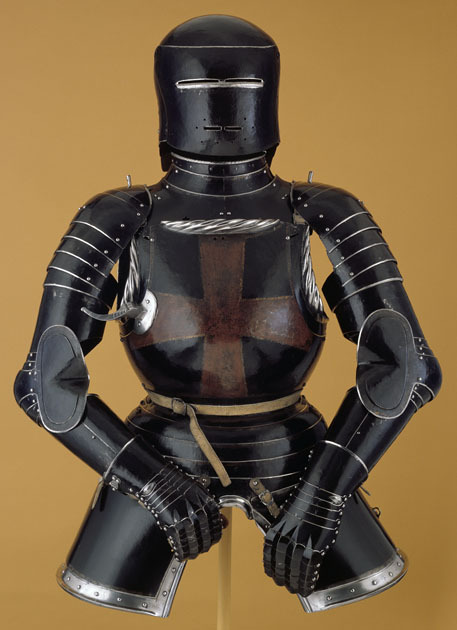
Or one who regularly cleans it…but yeah, “Black Knights” were called so because their armor was in terrible condition, and they were usually much more experienced, so they usually won tournaments.
I’m curious mainly where you got this concept from…
“Black Knights” need to be distinguished by context. I’m on my phone right now so I can’t link you all the sources I’d like to use, so please pardon me for that.
So, the concept of “knight in shining armour” comes from the idea of the knight-errant in medieval fiction, the sort of person who is on a quest, is all shiny and new, ready to test themselves. It also is a nod to the maintenance of equipment, or the wealth of a Knight; in the late medieval and Renaissance periods, well-off knights might have a suit of armour for warfare, a suit for tournaments, and a suit for formal occasions. These being used for different things, they were meant to be maintained well and show status and wealth.
So, where does the concept of a black Knight actually come from?
Surprisingly, most cases come from the idea of the tournament. Knights were meant to display who they were, “show their colours” (ie, heraldry), and show off their skills in combat. But if course you had some knights who didn’t want to show who they were, who they were fighting for, or which lady they favoured, etc. This sounds like a chivalric fantasy, and honestly, that’s what tournaments really became as time went by and the events became more formal.
Now, early “black Knights” , were those who did not wear dark or black armour, but in fact those who did not use their own heraldry, disguising themselves. Again, they may do this for various reasons, but the concept is they hide their identity. Occasionally, they might actually paint their shields black.
We also have the examples from the hundred years war where French and English knights painted their armour different colours: black for the French, Red for the English.
Some knights actually WOULD favour black armour or heraldry to the point they got called “black Knights”, and not as a derogative. The Polish Knight, Zawisza Czarny (pronounced “Zah-vu-shah Shar-ny”, approximately) become known for his feats of arms, and by his dark armour.
Linking back to the original quote, a Knight in shining armour could well be a black knight, as such. But more commonly, it meant he was either wealthy, or highly skilled at arms.
Or both. 😛
I’ve seen enough period art to convince me that “shining armour” was often a lot darker than the chrome-plated image which the term suggests.
I’ve also long thought that the whole business of “knights in shining armour” wasn’t a medieval concept at all, certainly not the default one, but was a Regency / early Victorian fictional conceit from Romance poets and Sir Walter Scott’s historical fiction. (About 10 years ago an actual expert said more or less the same thing, leaving actual amateur me feeling rather smug…) :->
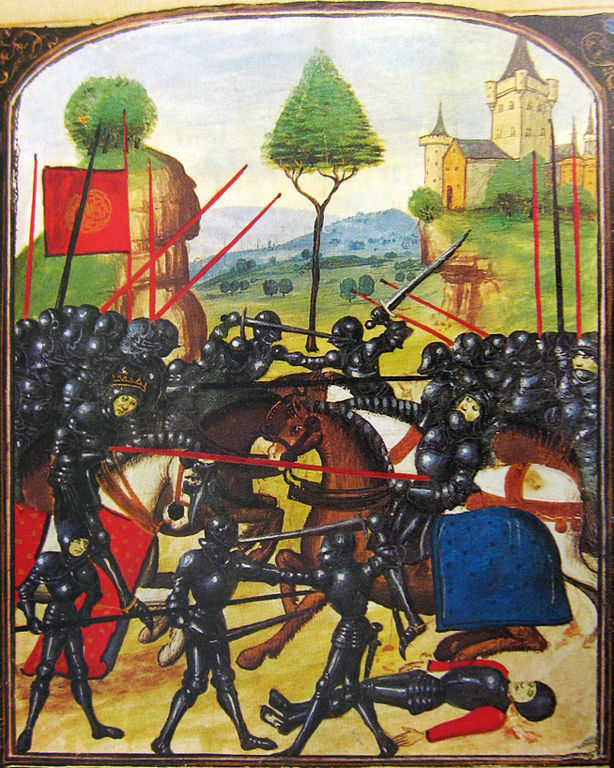
This illumination features armour that’s black or dark blue in colour, but with
the carefully-delineated highlights
of a shiny surface. There are many other like it.
Armour was coloured for both decorative and practical purposes; chemical blueing with acid produces a very dark, lustrous and effectively rust-resistant finish like the one in the medieval illustration. I once had an Arms & Armor rapier with that finish on the hilt: it looked like this…
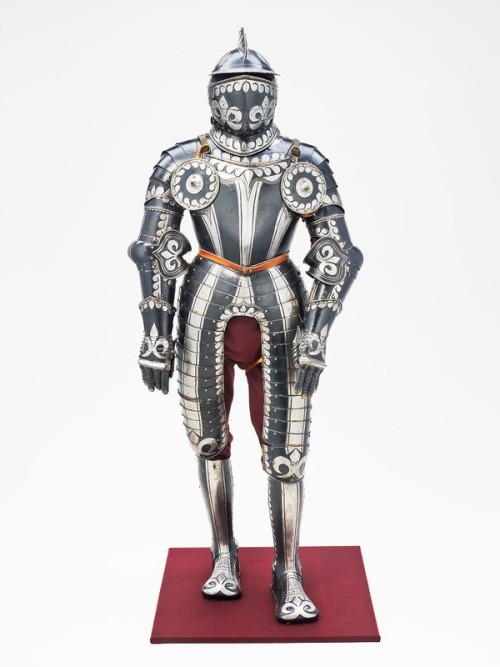
Heat-blueing, which was more blue than black, was a popular treatment for Greenwich armour of the Elizabethan period, as was browning and russetting (all of which were and are used on firearms), processes which used heat, chemicals or controlled “good rust” to create colour and also prevent uncontrolled “bad rust”.
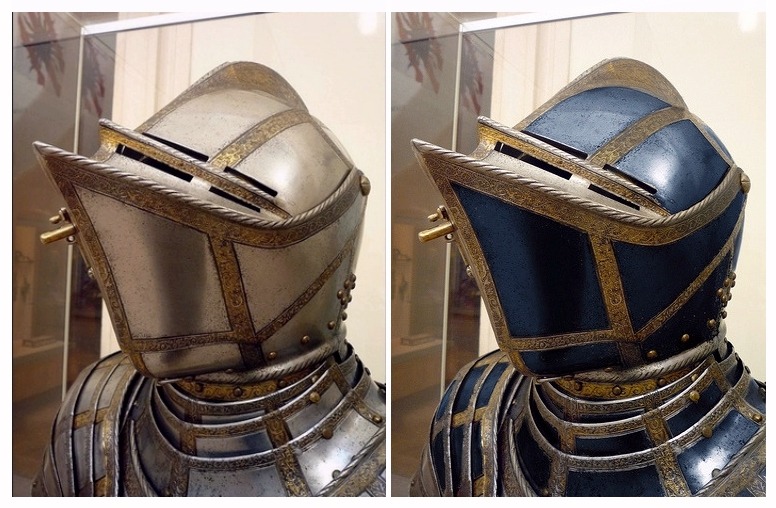
Here’s the helmet of Sir James Scudamore’s Greenwich harness, which was once blued and gilt.
The image on the left is how it looks now, after being thoroughly scrubbed with wire wool, sand or other abrasives at some stage in the 19th century to make it “shining armour”. The image on the right is a CGI restoration of its original appearance, based on still-visible traces of colour in the grooves beside the gold strapwork.
Here’s the browned and gilt “garniture” (armour with extra bits for different styles of combat, like a life-size action figure) of George Clifford, Earl of Cumberland. I don’t think grinding this beauty down to bright metal would be an improvement…
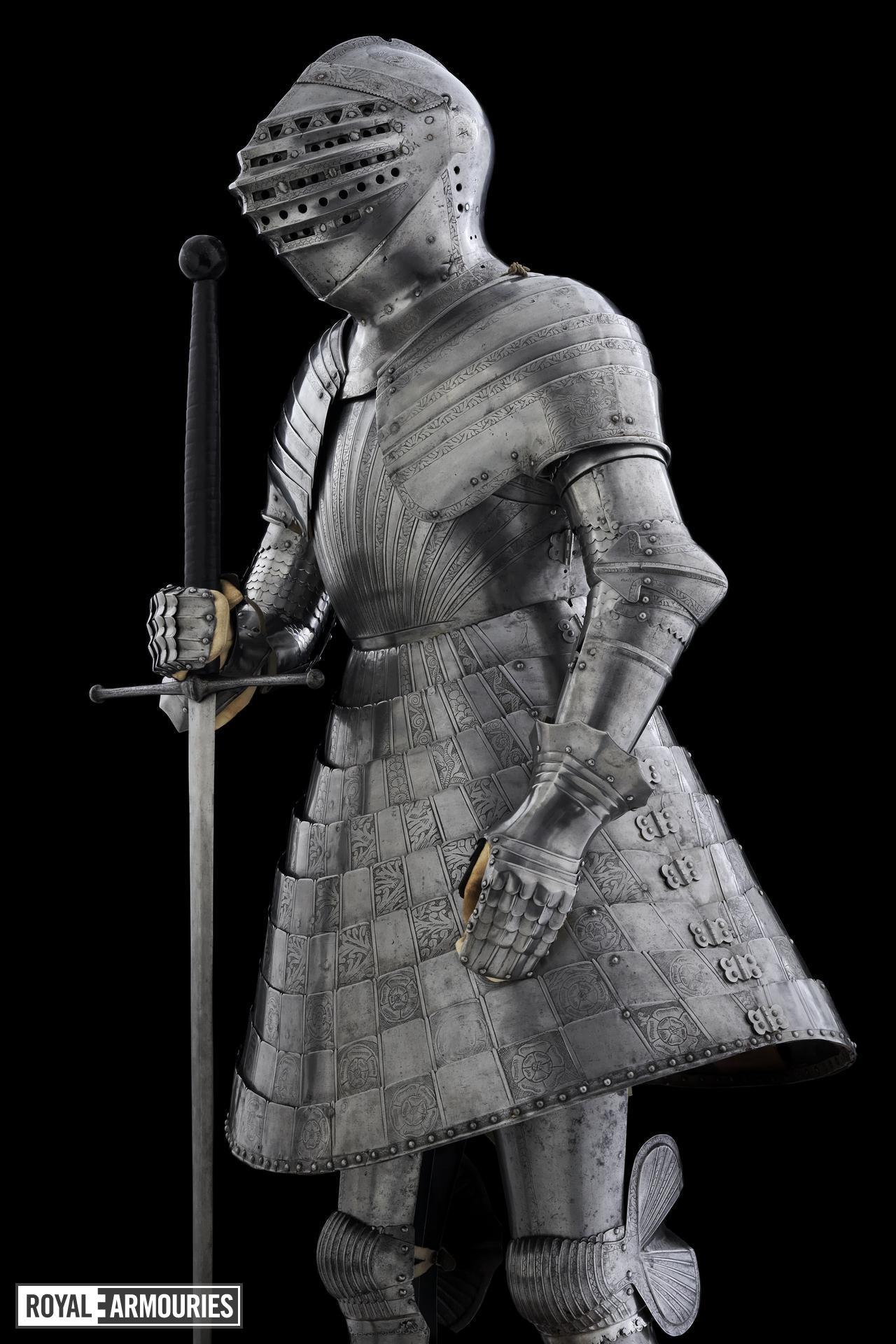
Henry VIII’s tonlet (skirted) armour for foot combat at the Field of the Cloth of Gold now looks like this:
Originally it would have been shiny black or dark blue with gilt details and the engraved panels picked out in coloured paint or enamelling – red Tudor Roses, green leaves etc., but that wasn’t “shining armour”, so…
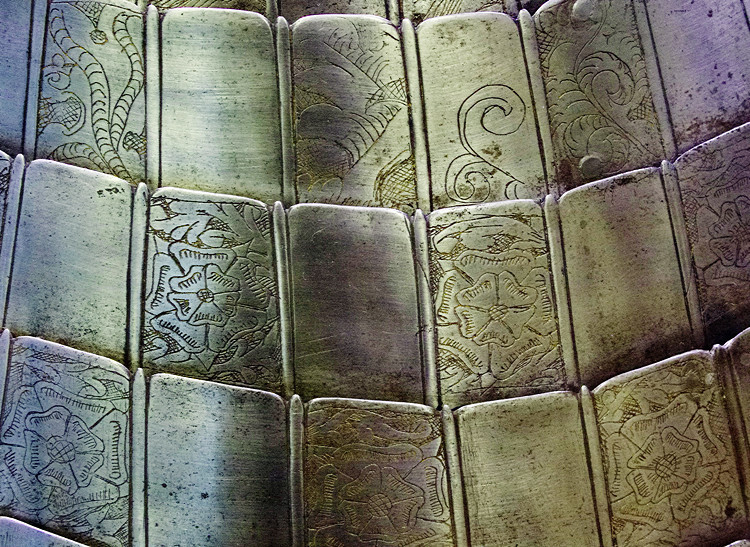
This detail shot shows the fine score-marks left after it was sanded “clean”, with dark pigmentation in the grooves as a memorial of how it once looked.
This Renaissance painting, “Portrait of Warrior with Squire”, shows black armour on the warrior and bare-metal armour on his squire, so it’s clear that armour in art wasn’t painted black simply because artists couldn’t properly represent burnished steel.
In this article, Thom Richardson, Keeper of Armour at the Tower of London and Royal Armouries in Leeds (the actual expert I mentioned at the beginning) comes straight out and calls Scott responsible for “shining armour” vandalism:
The sets of armour are not in their original black and gold because of
over-aggressive polishing in the 19th century when, said Richardson,
“they were polished with brick dust and rangoon oil to within an inch of
their life” to fit the aesthetic of what armour should look like, all
shiny and silvery. “Walter Scott is to blame,” Richardson added
ruefully.
Scott can also be blamed, according to the Oxford English
Dictionary, for creating or at least popularising that clunky, inaccurate term
“chain-mail”. It cites the first appearance in 1822 (recent when talking about mail) when a
character
in “The Fortunes of Nigel”
says:
“…the
deil a thing’s broken but my head. It’s not made of iron, I wot, nor my
claithes of chenzie-mail; so a club smashed the tane, and a claucht damaged the tither.”
Plate armour was also painted, either crudely…
…or with much more care (this style is actually called black-and-white armour); since the paint was oil-based, it also had a rust-proofing effect…
I have a notion that the more white there was on black-and-white armour, and thus the more work (by servants, of course!) needed to keep it looking good, may have been an indication of rank, status or success. Just a guess…
Armour left rough from the hammer – therefore cheaper than armour polished smooth, since every stage of the process had to be paid for – was also treated with hot oil in the same way cast-iron cookware is seasoned, again to prevent rust.
There were terms for bright-metal armour – “alwyte harness” and “white
armour” – but the existence of such terms suggests to me that they arose
from a need to describe an armour finish which needed a tiresome amount of maintenance to keep it that way. I’m betting that the last stage of a clean-and-polish was a good layer of grease, or even a beeswax sealant like the coatings used by museums today.
White armour may have been a demonstration of wealth or conspicuous consumption in the same way as black or white clothes: one needed servants constantly busy with polishing-cloths, the others needed really good colour-fast dye or lots of laundering, and all of those cost money.
One thing is certain: a knight in shining armour wasn’t the one who sweated to keep it shining. That’s what squires were for…
Just wanted to share this coming out story from a guy I saw on First Dates. He came out to his dad when he was 20, and then his mum when he was 21, after trying very hard to hide that part of himself and never really discussing anything like that in their household. Hearing his mother’s response after he explained all that was really gratifying. To all Muslim LGBT+ people, As-Salaam-Alaikum ❤
And to those who cannot come out to a response like this, please never forget that Allah is with you. I feel your pain and Inshallah, you will be brought peace. I’m praying for you.







 Dove's Tumblr Archive